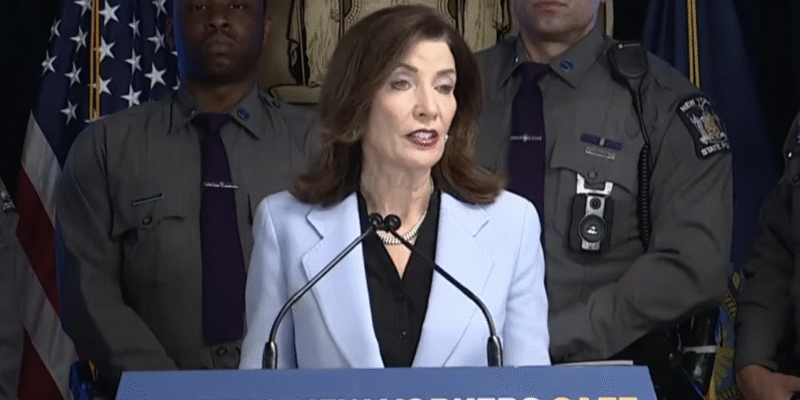

New York Gov. Kathy Hochul is putting another roadblock in front of the state’s growing data-center industry, this time urging communities to demand at least $1 million from developers for every megawatt of electricity their projects are expected to consume.
The announcement comes just two months after Hochul imposed what became the nation’s first statewide moratorium on new hyperscale data centers.
The governor's latest move is being billed as a way to make Big Tech “pay its fair share.” But for companies looking to build in New York, the message is becoming increasingly difficult to miss: Albany is making it more expensive and more complicated to invest.
Under Hochul’s new Community Investment Framework, local governments are encouraged to seek at least $1 million per megawatt of utility demand from proposed data centers. The benchmark is voluntary, meaning it is not itself a statewide tax or mandatory fee. But the numbers can get enormous.
A 50-megawatt facility, the threshold covered by Hochul’s moratorium, would translate into a recommended $50 million community investment under the new benchmark. And the state's regulatory freeze remains in place.
Hochul signed an executive order in July halting new state environmental permits for hyperscale facilities using 50 megawatts or more while officials develop new rules.
The governor said the pause could last up to a year. Hochul argues the restrictions are necessary to protect New Yorkers from higher electricity bills, strained infrastructure, water consumption and other impacts associated with massive AI facilities.
But the policy creates an obvious question: If data centers are such a burden, why has New York spent years offering incentives to attract them?
That question is particularly relevant in Rockland County, where data-center operators have benefited from hundreds of millions of dollars in state and local tax subsidies, according to a recent report. Data centers in the area have also received discounted electricity through a New York Power Authority program designed to encourage businesses to locate or expand in the state.
Now Hochul wants to eliminate tax benefits for hyperscale data centers while simultaneously demanding substantially larger community investments from future projects.
The governor has also argued that data centers create relatively few permanent jobs compared with traditional manufacturing while consuming enormous amounts of electricity. Her own administration highlighted that argument earlier this year when it called for data centers to pay their “fair share.”
The backlash isn't limited to New York.
Across the country, politicians are increasingly confronting the costs of the AI infrastructure boom. Congress is preparing to vote on bipartisan legislation requiring regulators to consider whether massive electricity users such as data centers should pay the incremental infrastructure costs associated with connecting them to the grid.
But New York has gone further than most states.
Hochul has simultaneously declared that New York wants the economic benefits of the AI revolution while putting the brakes on the infrastructure needed to support it.
For businesses, that creates uncertainty. For taxpayers and ratepayers, it raises another question: Are New Yorkers protecting themselves from the costs of the AI boom, or watching investment move somewhere else?
Data-center developers have already warned that New York’s moratorium could push investment outside the state. Digital Realty, one of the industry's major operators, told Reuters that a one-year pause was not the right approach and could redirect investment elsewhere.
Hochul says she is protecting New Yorkers.
Critics can reasonably ask whether Albany is instead making New York an increasingly difficult place to build.