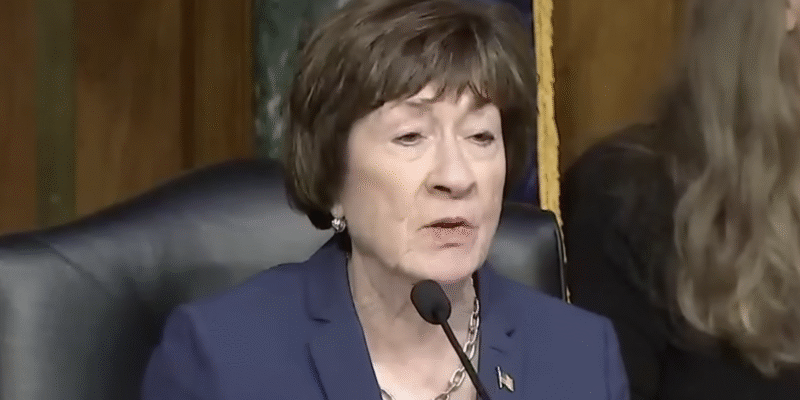

Republican Sen. Susan Collins lost her reelection bid Tuesday, falling to Democrat Troy Jackson in a major political upset that ends one of the longest congressional careers in New England and gives Democrats another pickup in their effort to reclaim control of the U.S. Senate.
The Associated Press called the race at 1:02 a.m. Wednesday, with Jackson holding a seven-point lead as approximately 75% of precincts reported. Collins conceded before the AP announcement, calling Jackson to congratulate him and promising a smooth transition.
"It has been the honor of my life to serve the people of Maine in the United States Senate," Collins said in a statement, according to Maine Public.
Collins, 73, had represented Maine in the Senate since 1997 and was seeking an unprecedented sixth term. Her defeat marks the end of a political career defined by her ability to survive increasingly difficult reelection campaigns in a state that has consistently supported Democratic presidential candidates.
Jackson, a former president of the Maine Senate and fifth-generation logger from Aroostook County, entered the general election campaign under unusual circumstances. He replaced Graham Platner as the Democratic nominee in July following a chaotic primary season, leaving him approximately 100 days to build a statewide campaign against one of the Senate's most established incumbents.
Despite the shortened campaign, Jackson successfully made Collins' relationship with President Donald Trump a central issue.
Jackson repeatedly argued that Collins had enabled Trump's agenda through her votes and support for administration priorities, despite occasionally breaking with the president. He also criticized her vote to confirm Supreme Court Justice Brett Kavanaugh, whose subsequent participation in overturning Roe v. Wade became a major issue in the campaign.
Collins attempted to separate herself from Trump, emphasizing her independent voting record, seniority and leadership of the powerful Senate Appropriations Committee.
She also highlighted her ability to deliver federal funding for Maine and argued that her experience gave the state an advantage in Washington.
That strategy had worked in previous elections, including her decisive 2020 victory over Democrat Sara Gideon. This time, however, the political environment proved considerably more difficult.
The defeat carries consequences well beyond Maine. Democrats' victory in the race contributed to the party's return to control of the U.S. Senate, giving them a significant opportunity to challenge Trump's agenda during the final two years of his presidency.
For Maine Republicans, Collins' departure creates a major political void. She was the state's most prominent Republican officeholder and one of the party's most influential figures in Washington.
Her loss also raises questions about whether Republicans can remain competitive in statewide Maine elections as the state's political alignment continues to favor Democrats.
For nearly three decades, Collins built a reputation as a Republican capable of winning in difficult political circumstances. Tuesday's results demonstrate that even that electoral durability had its limits.
After almost 30 years representing Maine in the Senate, Collins will leave Washington as one of the most consequential political figures in the state's modern history.